
The Gift
The Praemium Imperiale Award

All in all, just as these gifts are not freely given, they are also not really disinterested. They already represent for the most part total counter-services, not only made with a view to paying for services or things, but also to maintaining a profitable alliance one that cannot be rejected.1
Marcel Mauss on the gift-giving practices of Trobriand Islanders
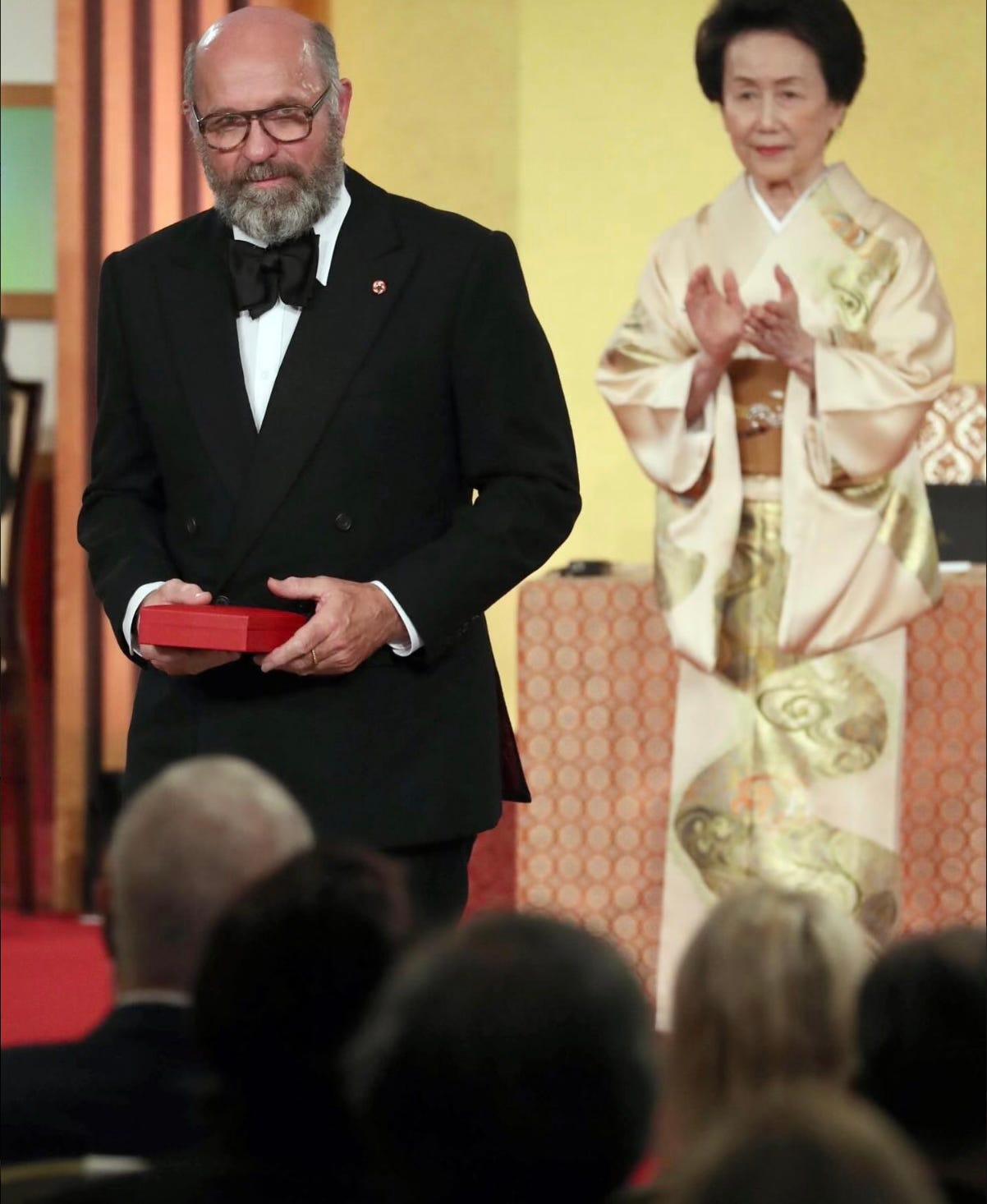
Peter Doig and Marina Abramović, two of the most world-renowned contemporary artists, have won the 2025 Praemium Imperiale, a generous gift from Japan’s Imperial Family and the Japan Art Association. On October 22, they were feted along with three other laureates at a formal, “star-studded” ceremony in Tokyo where Princess Hitachi personally awarded each a medal and a prize of fifteen million yen (approximately $100,000 USD).2
The Praemium Imperiale, or Imperial Prize, is one of the more curious art awards. I first heard of it two years ago when I was researching prizes for contemporary art.3 I was surprised to find that despite its Latin name, it is a Japanese award supported by the Imperial family of Japan and more often than not given to a non-Japanese artist. Many countries have national awards for recognizing the achievements of their citizens, but I don’t know of any that offer a national prize to foreigners let alone for a form of art that is not indigenous and is often politically and socially challenging.4 What, I wondered, has motivated this very generous gift? What “services” are being rendered and what “profitable alliances” are being made through this act of gift-giving?
To answer these questions, one has to look back at the political history of Japan and its relationship with Western nations. Prior to the end of World War II Japan was governed by the oldest monarchy in the world. The monarchy, under Emperor Hirohito (reigned from 1926-1989), endorsed Japan’s pre-war expansion in Asia with its attendant atrocities and the country’s 1940 partnership with Germany and Italy which then led to the bombing of Pearl Harbor.5 After atomic bombs decimated Hiroshima and Nagasaki, Japan conceded and American and allied forces moved in, occupying Japan from 1947-52. During that time, the allied coalition dissolved the political power of the monarchy, rewrote the nation’s constitution, and set Japan on its current course as a liberal democracy. The Emperor, along with the Imperial Household, was retained but only as a symbol of Japan and its culture.
One of the duties that the Imperial Household continued after the reconstruction was their sponsorship of cultural activities. Since the late 19th century, the Imperial family had taken an interest in nurturing the arts. In 1879, the Emperor noted the growing influence of the West on Japanese culture and in an effort to preserve and promote Japanese traditional art he created the Ryuchi-kai, an organization to supervise the “cultural activities of the Imperial Household.”6 A government dignitary was named as president, and a member of the Imperial family was given the position of honorary patron. Nearly a decade later, in 1887, the Ryuchi-kai was renamed the Japan Art Association (公益財団法人日本美術協会 ), an organization that under the patronage of the Imperial Family went on to establish art museums and exhibition spaces in Japan and to organize international touring exhibitions. In 1929, Prince Takamatsu, the brother of Emperor Hirohito, was named honorary patron of the Association. He retained this position for 58 years. He died in 1987 and his nephew, Prince Hitachi (the uncle of the current Emperor) took over as royal patron of the Association. During his tenure, Prince Takamatsu established the mandate that “Japan should promote world peace through the arts.”7 In recognition of this objective, and in keeping with the Prince’s “last wishes,” the Foundation established the Praemium Imperiale in 1988 with the first award given in 1989. The full English title of the award — Praemium Imperiale in Honour of Prince Takamatsu — reflects this tribute to the late Prince and the stated purpose of the award continues to adhere to Takamatsu’s belief that the arts can bridge nations and encourage peaceful co-existence. As the awards’ current mandate states:
Art and culture contribute greatly to the peace and prosperity of mankind. The Praemium Imperiale was established to honor individuals or groups from all over the world that make outstanding contributions to the development, promotion and progress of the arts.8
Since 1989, five awards, one each for painting, sculpture, architecture, music, and theatre/film, have been given to “global” artists (including Japanese artists) who have demonstrated “exceptional achievements.” Some of the notable laureates in the painting and sculpture categories include David Hockney (1989), Yayoi Kusama (2006), Anish Kapoor (2011), Ai Weiwei (2022), and Doris Salcedo (2024).9
The award’s extraordinary focus on nurturing peace through art and valorizing international artists, especially the most avant-garde, is related to another post-war event, the Venice Biennale. Before WWII, the Biennale featured a wide range of artistic styles – realistic landscape painting, genre painting, and folk art. Each participating country celebrated the artworks that they considered most representative of their nation and culture. It was not until the first Biennale after the WWII, in 1948, that this eclectic mix of artistic styles began to change and become more uniformly “avant-garde.”
Still recovering from the war, many countries, including Germany, did not participate in the 1948 Biennale. The organizers and participating countries thus used the event and empty pavilions to make a statement about art and freedom. In the Soviet Union under Stalin avant-garde art had been servely censored, and in Germany the Nazis had condemned many of the avant-garde artists as “degenerate.” In response to this attempt to stifle the free expression of the world’s artists, the organizers mounted an Impressionist and Post-Impressionist exhibition in the German Pavilion; American art collector, Peggy Guggenheim brought her collection of modern European art to Venice and exhibited it in the Greek Pavilion; and, a special exhibition of European modernists and “degenerate art,” including work by German artists like Max Pechstein and Erich Heckel, was presented in the Italian pavilion in the Giardini.10 It was also at this edition of the biennale that the Americans, fresh from their triumph in the war, debuted the work of their young Abstract Expressionists. The emphasis on avant-garde art was deliberate and provocative; a means of demonstrating the importance of the liberal-democratic values that had been challenged by fascist regimes and fought for by the allied forces during the war. As Rudolpho Pallucchini, the Secretary General of the Biennale, wrote,
A new spirit of freedom distinguishes the Twenty-fourth Venice Biennale from its predecessors. Not only were invitations extended to all nations possessing an artistic tradition but the Italian pavilion has opened its doors to every tendency. This would not have been possible in any country under a dictator’s rule.11
Prior to the war, Japan like many Asian nations had not participated in the Venice Biennale. In 1952, the same year that the occupation ended, Japan sent its first exhibition to Venice but may not have fully understood the aesthetic requirements. Their exhibition featured the work of eleven artists who were masters in Nihon-ga (Japanese-style painting) and Yōga (Western-style oil painting). The exhibition was “harshly criticized” and the organizers took a different tack for the next Biennale, sending only two artists, both of whom had studied avant-garde painting in Paris. Every year since, Japan, has joined Europe, the United States, and other nations in featuring their most avant-garde or contemporary art.12
Shortly after its debut at the Biennale, Japan solidified its commitment to the event and its values by building its own pavilion. Completed in 1955, the Japanese pavilion sits in the centre of the Giardini, right next to the European and American pavilions. The symbolism was obvious; after its loss in the war, and years of occupation and restructuring, Japan had joined hands with the West and adopted liberal-democratic values.13
The alignment of art, political values, and international relations is central to the Praemium Imperiale and prominent in how it has been structured and administered. From its inception, an advisory committee of foreign dignitaries was established to guide the award. This international advisory committee always includes former presidents and significant political representatives from Europe, the United States, and Japan. The current advisory committee, for example, consists of: Lord Patten of Barnes, the former Governor of Hong Kong; Lamberto Dini, a former Prime Minister of Italy; Hillary Rodham Clinton former First Lady of the U.S.A., presidential candidate, and former Secretary of State; Jean-Pierre Raffarin, former Prime Minister of France; and, Klaus-Dieter Lehmann, former President of the Goethe-Institut. Unlike other awards which rely on art professionals, this committee is responsible for nominating prospective artists. Members of the Japan Art Association then make the final selection.
Like important political rituals, the award-giving program follows the same format every year. Each summer, the winners of the Praemium Imperiale are announced. This is done very formally in either the United States or in one or more European capitals and hosted by advisory members. There is a press conference with the artists in attendance and usually some formal event like a reception or luncheon. Until 2015, these events were typically held at major museums or national palaces and hosted by a national president or member of a royal family. In 2002, for example, the official announcement ceremony and banquet were held at the Château de Versailles, followed the next day by a reception hosted by President Chirac at the Palais de l’Elysée in Paris. Since 2015, these events appear to have been pared down to a series of press conferences in London, Berlin, Paris, Rome, and New York.
The award ceremony, itself, occurs in the Fall and is always held in Japan often at the Meiji Kinenkan on the grounds of the Imperial Palace in Tokyo. The gala event is attended by the advisory members as well as Prince Hitachi and his wife, Princess Hitachi, former laureates, and an a-list of dignitaries. The role of art as a champion of liberal-democratic values and a salve for global woes is then celebrated in the speeches given at the event. This year, for example, Hillary Clinton, the Secretary of the advisory committee noted
We live in an age of noise and division. And we recognise art is not just for beauty or entertainment but it serves a central role in our society and in the common human experience. It is a powerful vehicle for diverse ideas and expressions that inspire us, challenge us and heal us.14
A member of the Japan Art Association, Takamitsu Kumasaka, remarked that, “through the Praemium Imperiale, we will continue striving to advance art and culture and contribute, even in small ways, to peace and prosperity in the world.” And a written message from Tokyo’s Governor, Juriko Koike, noted, “Precisely because we live in an unstable and uncertain age, culture and the arts, which bring healing and hope to people and serve as bridges between different values, are needed more than ever.”15
The Praemium Imperiale is not just an award, it is a gift that is clearly in the “service” of making a “profitable alliance” between Japan and its post-war allies. After the war, Japan needed to redefine its identity and reassure the West it had left its military aggression behind. As the symbol of Japan, the Imperial family had to follow suit and incorporate Japan’s new identity into own. As benefactor of the gift, the Imperial Family is Japan, and Japan is the generous host who invites the guests to attend a ritual centered around shared common beliefs. The guests, in this case the advisory committee members, represent the two sides of a war that generated the most horrendous atrocities the world has ever seen. It is likely no coincidence then that the advisory committee over the years has had a representative from only six nations: the United Kingdom, France, and the USA which represent the Western allies and, Germany, Italy, and Japan that formed the opposing side.16
The artists, meanwhile, are the symbolic muses of this political ritual. As artists, they create symbols that people can attach meaning to and, in this case, art is being recognized as a symbol of the liberal democracy that triumphed at the end of the war. As muses, the artists are politically neutral. They do not represent any one nation. Abramovic, for example, was born in Serbia, has lived in Holland and Germany, and now lives in the United States. Doig was born in Scotland, but has lived in several countries including Canada and Trinidad before settling in London. Moreover, the artists are universally renowned across nations and cultures which adds to their symbolic value and, on a utilitarian level, provides popular name recognition that draws the media to report on the award and events. Neither artist speaks for nor creates art primarily about any one nation. Their artwork, in fact, has little relation or significance to the political issues that shaped or brought an end to the war. And that is the point. Their creative achievements, like the artists themselves, remain neutral to the previous enmity between these nations. Instead they form a bridge between them and represent the values and bond they now share.
The gift – an award of money and recognition – is, like the rituals of the Praemium Imperiale, also a symbolic gesture. Over the years, none of the nominated artists has needed more recognition or financial support. The real star of the Praemium Imperiale is then not the artists but the gift and the ideals it represents. In his book, The Gift: The Form and Reason for Exchange in Archaic Societies (1950), Marcel Mauss relates a similar story of gift-giving. In the ancient tale of King Arthur, the king is said to have commissioned a “miraculous Round Table.” Its round shape with no single seat higher than another united his quarrelsome knights and put an end to their “stupid struggles, duels and murders.”17 The table was Arthur’s gift. Even though he was king, Arthur gave up his place at the “high table” in return for the peaceful unification of his warriors. Thereafter, “everywhere that Arthur took his table his noble company remained happy and unconquerable.” The moral that Mauss gleans from this tale may just as well apply to the Praemium Imperiale. In giving a gift, Japan offers a “counter-service” to solidify the peaceful “alliance” between former enemies so that
nations today can make themselves strong and rich, happy and good. Peoples, social classes, families, and individuals will be able to grow rich, and will only be happy when they have learnt to sit down, like the knights, around the common store of wealth.18
In recognizing the world’s artists with a generous gift every year, Japan invites the former adversaries to gather around the arts and renew their alliance so that all may be “strong and rich, happy and good.”
Marcel Mauss, The Gift: The Form and Reason for Exchange in Archaic Societies (London: Routledge, 1950), 94.
Joe Ware, “Peter Doig and Marina Abramović celebrated at star-studded Praemium Imperiale ceremony,” The Art Newspaper (October 23, 2025): https://www.theartnewspaper.com/2025/10/23/peter-doig-and-marina-abramovic-celebrated-at-star-studded-praemium-imperiale-ceremony
See my post, “And the Winner is…”
Praemium Imperiale has often been called the Nobel Prize of the arts and is similar the wealth of the prize, the ceremonial formality, and the objective to promote global peace. The Nobel, however, was founded by the estate of a wealthy citizen and, although seated in Norway and Sweden, does not directly represent these nations.
Japan signed the Tripartite Pact or Berlin Pact with Germany and Italy in 1940, agreeing to form a military alliance to keep the United States from joining the war.
https://www.praemiumimperiale.com/en/jaahistory/ I could not find a date to confirm when this mandate was initiated. My guess would be that it occurred during or after the reconstruction. In his life time, Prince Takamatsu was noted for being against Japan’s aggressive actions even before the war, and after the war he was recognized for his many philanthropic activities.
I could not find a clear statement on who funds the award. The award webpage cites Japanese corporate donors but these may be in addition to funds from the Japanese government and the Imperial family. https://www.praemiumimperiale.com/en/endow/
Philip Rylands and Enzo di Martino, Flying the Flat for Art: The United States and the Venice Biennale: 1895-1991 (Richmond, Virginia: Wyldbore & Wolferstan Ltd., 1993), 90.
Quoted in Joe Ware, The Art Newspaper.
“The 36th Praemium Imperiale honors global artists in Tokyo ceremony,” Japan Forward (October 23, 2025). https://japan-forward.com/36th-praemium-imperiale-honors-global-artists-in-tokyo-ceremony/
The award website does not provide a complete list of advisory members but the ones it does provide are all from these six countries. Furthermore, the awards are always announced in these same countries, except for in 2008 when Moscow was included in the press conference round. https://www.praemiumimperiale.com/en/advisors/ https://www.praemiumimperiale.com/en/pichrono/.
Mauss, The Gift, 106.
Mauss, The Gift, 106.
What a wonderful initiative from Japan. Thanks for writing about this.
We’d never learned any of this as Japanese. The way you brought Marcel Mauss into the historical and political context of the Praemium Imperiale clarified things we hadn’t really thought about before. And yeah, the post-1945 order is clearly shaking now. It makes us wonder what artists who care about freedom and peace can still hold on to.