
The Brutalist
A Portrait of the Modern (and Contemporary) Artist

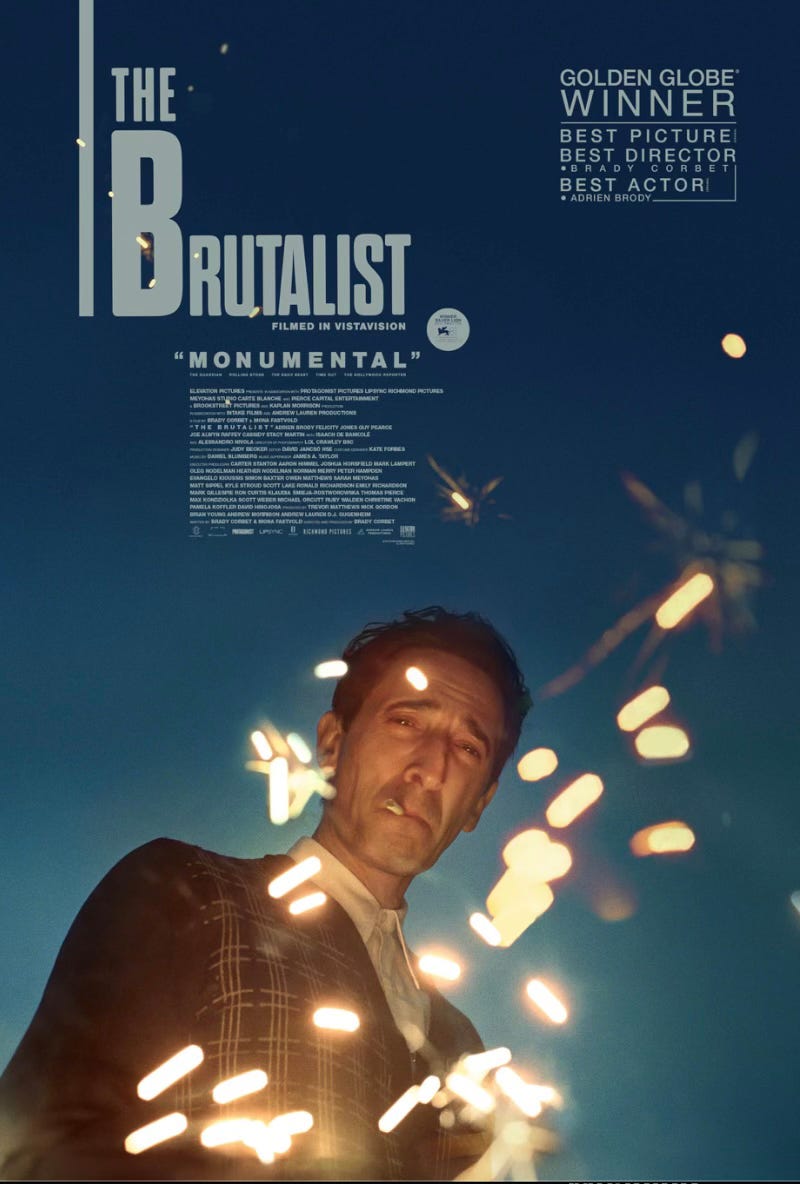
Spoiler Alert! If you haven’t seen The Brutalist you may want to stop reading here.
The Brutalist is a powerful film. At its simplest it is the redemptive tale of a Jewish-Hungarian architect who, before WWII, is a star of modernist design in Budapest and who, after the war, struggles to establish his artistic reputation in the United States. We are introduced to László Tóth in the first few minutes of the film. In a whorl of images accompanied by an edgy soundtrack, Tóth is propelled away from the horror and chaos of post-war Europe and into the waiting arms of his American cousin in Philadelphia. In this brief abstract segment, we are given no information about Tóth, only the impression that he has suffered and left a harrowing situation behind. That is the beauty of the film – Tóth’s story and trauma are never related literally; instead, the facts of his life are slowly unfolded in the nuanced performances of the actors and the interactions of the characters. What emerges, and what caught my interest, is how The Brutalist is so vividly a portrait of the classic modern artist as described by sociologist Nathalie Heinich in her book, The Glory of Van Gogh.1
Heinich proposes that the modern artist as we know him (the modern artist is usually male) was born at the end of the 19thcentury with the posthumous glorification of Vincent van Gogh. Disparaged for his unusual painting style and suffering from illness and poverty during his lifetime, van Gogh’s reputation was resurrected and glorified soon after his death. Posthumous exhibitions and essays, books, films, and media coverage that continue today have made him an international sensation. We now know van Gogh, the “accursed artist” (140), not so much from his paintings, but from the narrative that has been told of his life.
The story of van Gogh’s traumatic journey to recognition follows a now-familiar trajectory: the artist’s work is initially viewed as unconventional and abnormal and gains little attention from the public. Because of this rejection the artist lives an abject life, often struggling with health, addiction, and poverty. The artist, by choice or from prejudice, associates with social outsiders and outcasts. Only a few supportive advocates – a “father, brother, friend, producer” (142) or wealthy patron – encourage and support the artist through his lifetime. Then, late in life or after his death, his significance is finally celebrated. It is this “legend of van Gogh” that Heinich contends formed a new paradigm, a “founding myth,” about the modern artist whose “degeneration in the present proves his future greatness, while bearing witness to the pettiness of the world (‘society’), which is guilty of not having recognized him” (140-41).
The Brutalist follows this same paradigmatic storyline in constructing the artistic character of Tóth. As we enter the story, Tóth’s artistic genius is not at all evident. He is introduced as just another tired immigrant landing on Ellis Island. His American cousin, who knows of his abilities, takes him in and puts him to work in his furniture business. Only then do we get a hint at Tóth’s artistic difference. He designs a tubular chair that looks nothing like the American colonial-style furniture sold in his cousin’s shop. His cousin’s American wife demonstrates her incomprehension and derision when she scoffs at Tóth’s design and says that the chair looks like a tricycle.
Tóth’s cousin continues to support Tóth despite his wife’s biting remark. He wrangles a contract with a wealthy patron and lets Tóth lead the project to redesign a library located in the family mansion, a tall Victorian house that looks like it came straight out of Hitchcock’s Psycho. Tóth removes the drapes and neo-classical features of the room and designs a “less is more” modern space furnished only with a tubular chaise longue and bookshelves that are hidden behind louvered slats. The owner returns home and is furious. Unable to understand what has been done to his beloved library, he fires Tóth and his cousin. This rejection and misunderstanding leads to a falling out between the cousins. Tóth is cast out into the dark streets of America where he must live in homeless shelters and take up temporary construction jobs. His life becomes one of toil along with immigrants and working poor. His only friend is a Black man, a single father he meets in a breadline. Together they look for work, shoot heroin, and hang out in smoky jazz clubs.
The wealthy patron in the meantime learns of Tóth’s European fame and his unique library is featured in a fashionable design magazine. The patron is a collector of rarities - books and wine – and now wants to collect Tóth, a rare find in an America that has not yet embraced modern design. The patron tracks Tóth down and hires him for a major vanity project – a building for the nearby community that is to include a library, gym, and chapel. This project becomes another major struggle in Tóth’s “hero’s journey.” He works hard to design the perfect building to match the patron’s vision with his own aesthetic sensibility. Tóth must continually assert his artistic integrity and maintain his ideals against the objections of non-believers, one of whom is the patron’s son. At one point, Tóth leaves the project and again must find employment, this time as a draughtsman in an architectural firm. He and his wife, who finally joins him in America, struggle financially and personally in coming to terms with their long separation, the trauma of the Holocaust, and, of course, Tóth’s artistic struggle.
In the final segment, the film fast-forwards to the year 1980. An aged Tóth is finally recognized and honoured for his artistic achievements, including the patron’s building. His niece, who also survived the Holocaust, addresses the audience at the first architecture biennale in Venice and summarizes Tóth’s greatness to an adoring crowd.
With this storyline, The Brutalist neatly illustrates what Heinich calls the “van Gogh effect” (150). Tóth’s recognition, and ultimate fame, arise from the valorization of a set of conditions that also supported the glorification of van Gogh and later modernist artists. First and most significantly, the story valorizes the abnormal over the normal, making what is different or out-of-the-ordinary a special feature for recognizing an object as art. As Heinich explains,
abnormality is no longer valued as an exception, but as the rule. The normalization of the abnormal is an a priori principle of excellence that applies to every artist. Henceforth, normality in art consists of being outside of the norms (143).
In modern art this abnormality is typically demonstrated in how the artist challenges the shape and form of art – van Gogh’s unusual style of painting or Tóth’s tubular chair, for example – or in the unconventional subject matter of the work – Edouard Manet’s Le Déjeuner sur l’herbe (1863) or Salvador Dali’s The Persistence of Memory (1931) for example. The abnormal feature, which in a “normal” world would be ignored or ridiculed, is viewed as a valuable asset that makes the artist’s object special and worthy of being art.
With the valorization of the abnormal, what is normal such as the “the notion of beauty is discredited as a standard for evaluating the quality of works of art”(144). Beauty, Heinich notes,
becomes a secondary end when the expression of an artist’s own personality, creative process, or experimentation counts for a lot more than the production of delightful objects for the consumer. This relative dismissal of the criterion of beauty marks a change in the nature of evaluation. The latter now focuses on an earlier phase of the creative process, on the producer instead of the spectator. Henceforth, the work is to be judged less in function of the spectator’s feelings, and more in function of what the producer was “trying to say”(144).
In other words, what matters is not how the viewer understands or feels about the work, but what the artist was trying to convey. This switch introduces a new focus on, and valorization of, the artist’s “interiority” (143) — their feelings and thoughts. The modern artwork is thus valued as an expression of the artist’s inner life, including their trauma and troubles.
The valorisation of the artist’s inner motivation is beautifully rendered in The Brutalist. The public does not appreciate the aesthetic value of Tóth’s unusual building plan or understand what he is trying to achieve. And, when the patron hires a local architect to help bring the costs of the project down, it is clear that even a fellow artist does not understand or have access to Tóth’s creative vision. Over time, and close to the end of his life, Tóth’s design is finally deemed to be beautiful.
Finally, the valorization of abnormality bestowed on the modern artwork is attached, by association, to the person of the artist. The abnormal personal differences of the artist – reclusiveness, mental disorders, addiction, eccentricity, personal trauma – are all valued as signs of the creative personality and the artist’s singular vision. The artist’s differences then are viewed as caused by the creative impulse as much as the creative impulse causes the dissolution of the artist. Thus, the real-world suffering of the artist, as we see in the life of van Gogh and Tóth, only reinforces the idea that the artist’s creativity, the expression of his innermost feelings, may be troubled but they are also authentic and not easily won.
With these values, the new modern paradigm supports the image of the artist as a creative, but misunderstood genius. Like van Gogh and Tóth, the artist is driven by his vocation and, despite all odds, continues to make art. Artmaking is like an addiction, one that the artist cannot resist. No matter what, he has to make art even if this means being misunderstood and living in poverty. And, as Heinich explains, “all genuinely innovative creators can only clash with the common outlook, with their contemporaries’ doxa [common beliefs] because they contravene the accepted norms” (145). As a result, recognition is often delayed and can only happen late in life when the “abnormal” has finally become the accepted “normal.”
The “van Gogh effect” is based on Heinich’s study of the origins of modern art in the nineteenth century. Much has changed in the Art World since, but the values of the modern paradigm persist, albeit in different forms and according to a more rapid valorization process. Like modern artists, contemporary artists are valued for, and are required to present, work that is original in its difference whether in a formal sense (the type of work, medium, etc.) or in the subject matter. But, in a contemporary art world where the “abnormal” quickly becomes the “normal,” artists are challenged to distinguish themselves. As a result, since the end of the nineteenth century, new media, new subjects, and new ways of presenting art have rapidly transformed what we now know and accept as art.
In contemporary art, creativity is still viewed as a special attribute of the artist, something that comes from within and is unique to that artist. The Art World, and the world generally, value creativity in any form, but art is considered special for the meaning people attribute to it. As a consequence, despite their differences artists are valued for their presumed wisdom, intelligence, and unique vision of the world. Even conceptual artists, who claim their work has no significant meaning, cannot escape the valorization of their own originating idea; that their art has no meaning.
And today, more than ever, an artist’s abject identity is given remarkable value. The difference is that this value is now more often bestowed on an artist during their lifetime. While illness, addiction, and Bohemian lifestyle are no longer the favoured afflictions, other differences have emerged in the context of current social movements. Artists who identify as Indigenous in the colonized nations of the World; Black artists whose ancestors endured slavery in the Americas and centuries of racism; female, gay and trans artists who have had to fight to gain recognition in society; political dissidents who have suffered at the hands of repressive governments; long-dead and forgotten artists; and, artists from around the globe who have not yet had a voice in the artistic centres of the contemporary art world are all given extraordinary value in an Art World that has historically been dominated by the “norm” of the modern Caucasian Euro-American male artist. The contemporary artist’s non-conforming identity is not only a sign of their difference (as it was for van Gogh), but also the source of their “interiority,” their special insight that makes their artwork singularly unique. We know and value this singular artistic vision because of the stories that are told, not only in curatorial texts, but over and over in tales like The Brutalist which keep the modern “van Gogh effect” alive in the contemporary.
Nathalie Heinich, The Glory of Van Gogh: An Anthropology of Admiration. Trans. Paul Leduc Browne (Princeton, NJ: Princeton University Press, 1996). All quotes are from this volume thus page numbers are bracketed in the text.
This was great. I haven't watched the movie yet but now will have to