

A short post this week to fill you in on some news about the Sobey Art Award.
The Sobey Art Award has been celebrating Canadian contemporary artists for just over twenty years. Each year, curators from across the country choose a longlist of artists from five different regions across the country: West Coast and the Yukon, Prairies and the North, Ontario, Quebec, and the Atlantic. Five artists from each of these regions form the longlist of 25 which is then honed down to a shortlist of five artists, one from each of the five regions. The artworks of the shortlisted artists are then included in a group exhibition at the National Gallery in Ottawa. Finally, in the Fall, a winner is announced.
The prize, funded by the Sobey Art Foundation and the Sobey family of Nova Scotia, is the largest in Canada. Each longlisted artists is given $10,000, the shortlisted artists $25,000, and the winner $100,000. The value of this award is not only its monetary value. For over twenty years, the award has also put a "spotlight"1 on artists from every part of Canada. The exhibition and publicity bring these artists into view, not only in Canada's artistic capitals like Vancouver, Toronto, and Montreal, but also in the international centres of contemporary art.
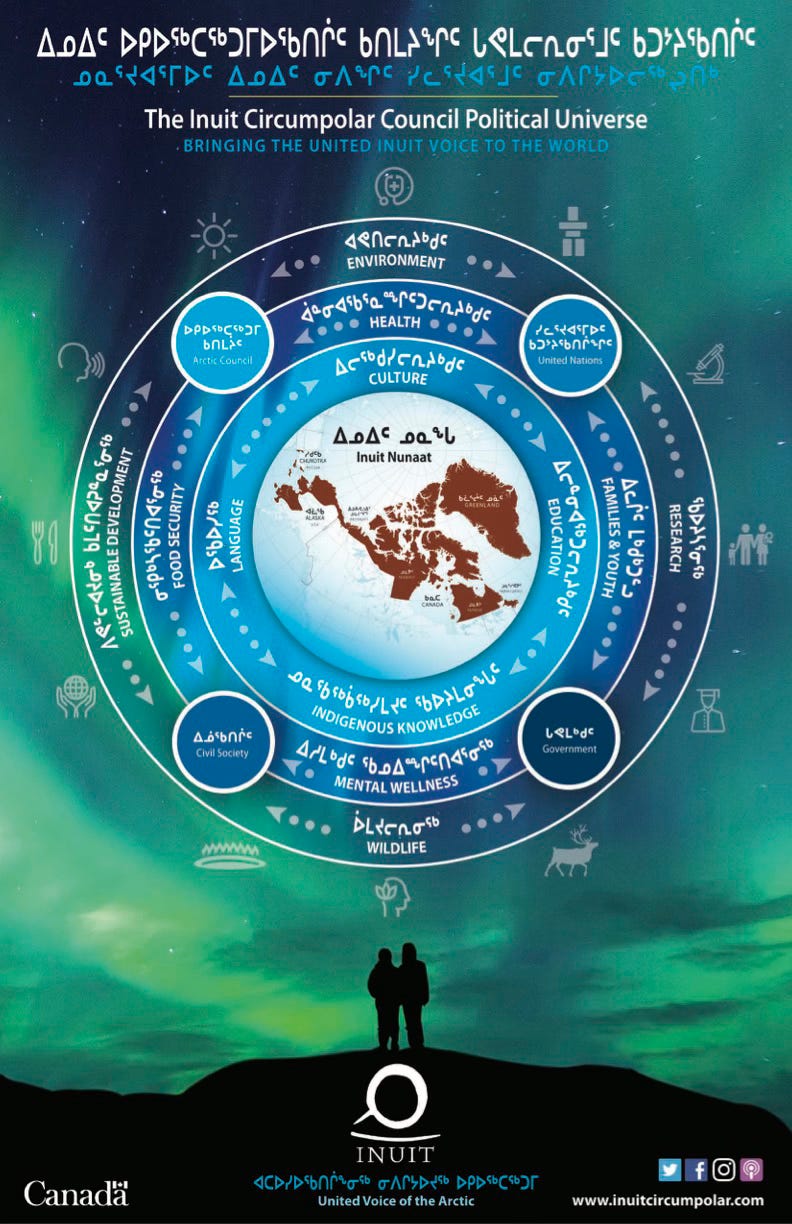
On February 21st, the National Gallery announced that a new region would be added to the award program: the Circumpolar region. This means that 30 artists from across six regions of Canada will now make the longlist. The Circumpolar region is pretty well the whole of northern Canada which includes the Yukon, Northwest Territories, Nunavut, Nunavic (Northern Quebec), and Nunatsiavut (Northern Labrador). Together the latter three areas are called Inuit Nunangat by the indigenous Inuit who populate most of the circumpolar region of the globe. The region, then, covers almost 40% of Canada's land mass and is populated by approximately 200,000 people living in scattered communities, many of them only accessible by air, or boat in the summer months. Because of this small population and the severe lack of services, the region is often dependent on the provinces in the south. People in the Yukon, for example, access advanced medical and educational services in British Columbia and people in the Northwest Territories are serviced in Alberta, Saskatchewan, and Manitoba. Similarly, in the east, Iqaluit, Nunavut is connected to Ontario. The previous Sobey Art Award regions did the same, tethered the northern regions to the south with the Yukon attached to the West Coast and the rest of the North attached to the Prairies. The northern communities in Quebec and Labrador were not even mentioned. Adding the Circumpolar region to the Sobey Art Award is then a strong statement that recognizes the autonomy of this northern part of Canada. Not only will the award direct a "spotlight" on the contemporary art of this region, but it will also make the communities and people more visible to Canada and the world.
As the Sobey Art Award puts out a call for nominations for 2025, the challenge will be to identify the artists of merit in the north and find a curator who can sit along with the other regional curators on the jury committee. Most circumpolar communities have little in the way of arts infrastructure and, as a result, have relied on galleries and Art World advocates in the south to promote and sell their work.2 Now with the spotlight turning, the north and its artists have an opportunity to join the global south, not as an adjunct of another region, but as an autonomous community with its own unique expression of contemporary art.
In 2012, on the occasion of the 10th anniversary of the prize, the chair of the Sobey Art Foundation, Donald R. Sobey wrote that the Sobey Art Award was created "as a means to recognize and promote contemporary Canadian art and to shine a spotlight on the talented and dynamic young artists in this country." In Ray Cronin, Sara Fillmore, and Donna Wellard, Sobey Art Award/Prix artistique Sobey: 10th Anniversary/10e anniversaire (Halifax: Art Gallery of Nova Scotia, 2013), 2.
See my post, Kinngait: An Art Centre on the Periphery.