
(Re)Discovered Women
Lesley Dumbrell and Pacita Abad

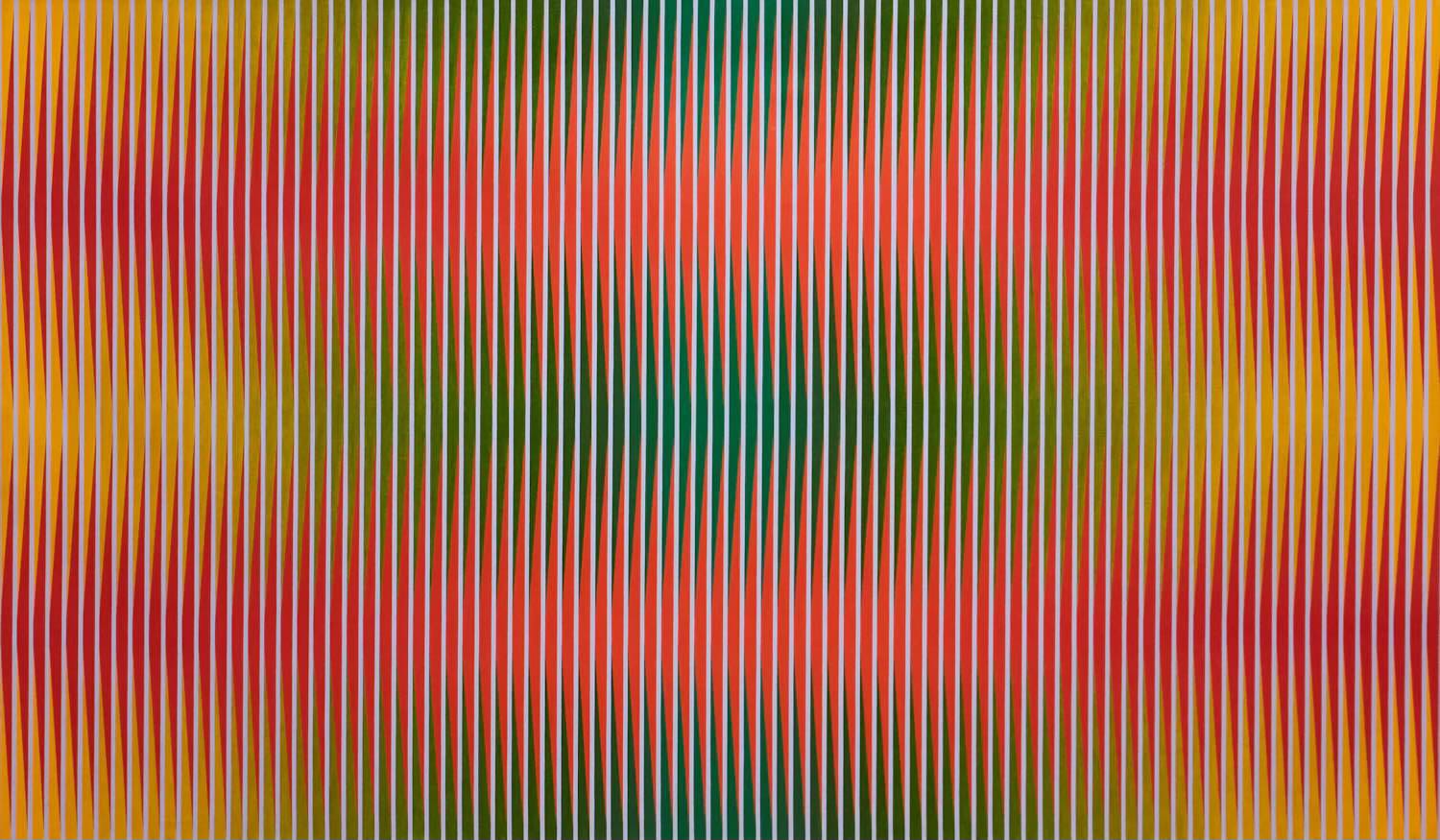
Female artists of a certain age — usually in their seventies or eighties — or women who have already passed on, appear to be having a renaissance in the world of contemporary art. Paula Rego, Etel Adnan, and Carmen Herrera, for example, are artists I had never heard of until a few years ago when their major exhibitions made headlines in the art press and popular media. After many years of living in the background these artists are now being celebrated in the contemporary art world.
This past summer, I was introduced to two more (re)discovered women artists: Lesley Dumbrell and Pacita Abad. Lesley Dumbrell was recently given her very first survey exhibition in a national museum in her native country, Australia. Dumbrell is 82 years old. A Guardian article brought Dumbrell to my attention. Dumbrell is noted for her colourful, optical abstract paintings, a style she has perfected since the 1970s. Her exhibition, Thrum at the Art Gallery of New South Wales in Sydney, featured over 90 of her works. Viewed on-line, her paintings are impressive for their scale, dynamic colour patterns, and sheer vibrancy. They would not be out of place next to the work of more renowned artists like Guido Molinari, Frank Stella, Vasarely, or Bridget Riley.
Unlike Dumbrell, Pacita Abad never reached the ripe old age of eighty. She died of lung cancer in 2004 at the age of fifty-eight. Now, twenty years later, her work is being featured in major exhibitions. Adad’s work was included in Stranieri Ovunque/Foreigners Everywhere, the international exhibition at this year’s Venice Biennale. She has also finally been given a retrospective exhibition, Pacita Abad, that covers her 32-year career and features over 100 paintings, prints, and works on paper. Curated by the Walker Art Centre in Minneapolis in 2023, the exhibition is now touring North America. It was shown at MoMA PS1 in New York over the summer and it opens at the Art Gallery of Ontario (AGO) in Toronto on October 9.
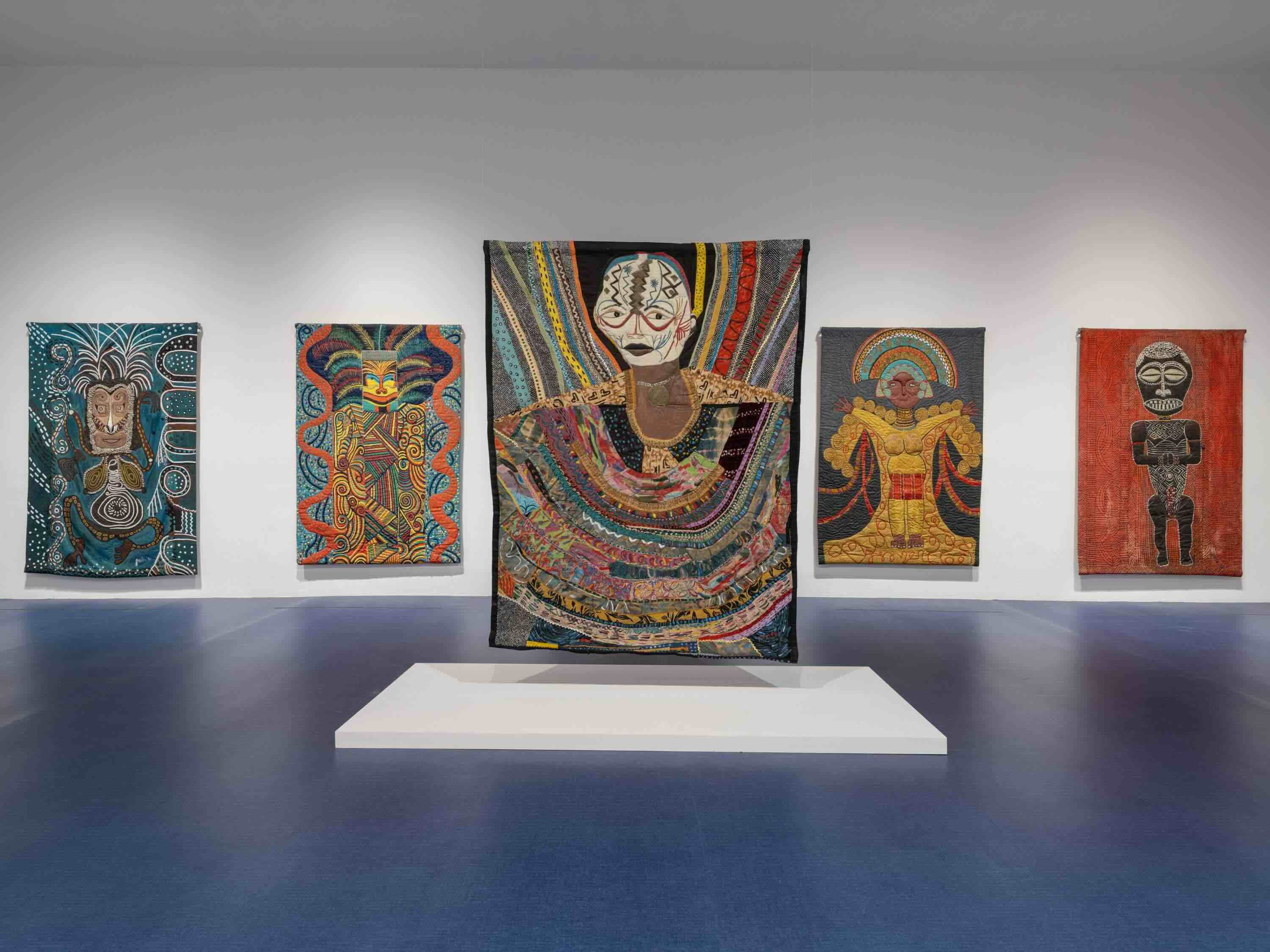
Abad’s work is more difficult to categorize. Her work is representational rather than abstract and often political in how it directs the viewer to consider contentious topics like global migration, American immigration, and the politics of the Philippines — Abad’s birth country. Abad also developed a form of tapestry/painting called trapunto. Rather than stretching her large canvases on frames, Abad used the canvas as a base that could be easily folded and carried with her. She and her husband travelled the world for his work so a flexible surface was essential. She painted on the canvas but also built it up into a relief by stitching fabric and other items such as beads, buttons, and sequins on the surface and by adding stuffing under some of the forms.
Both of these women come from the peripheries of the Art World, one from Australia and the other from the Philippines. Dumbrell remained in the southern hemisphere and developed an artistic career in Australia and Thailand where she has a second home. Her work has had little exposure beyond these two countries. And, while Australia’s national art museum calls Dumbrell “one of Australia’s most significant and respected abstract painters” it is odd that they are only now recognizing her with a major retrospective exhibition.
Abad, on the other hand, moved to the United States in 1970 and spent time in New York. She enrolled in art courses at the Corcoran School of Art and the Art Students League, and actively pursued exhibition opportunities and commissions. Abad’s gender, racial identity, peripatetic lifestyle, and her unusual form of art may have contributed to the lack of recognition that is only now being remedied.
To enjoy more on these two (re)discovered female artists see Dumbrell’s personal website (here) and the museum webpages on Thrum. Perhaps indicative of Dumbrell’s lack of recognition, there are no decent videos of her work other than very short clips on social media platforms.
I learned of Abad through Enzo Escobar’s excellent article, “Pacita Abad Sees the Soul of an Artifact,” on the online art journal, Momus. You can also find more background on her life and work on her personal website (here). The MoMA PS1 website has the best images and resources on her retrospective exhibition. Again, videos of the artist are scarce but the MoMA site offered the video below which was the only one I could find where Abad speaks for herself. Like her art, she is colourful and exuberant and it is difficult to see how she was not (re)discovered sooner.