

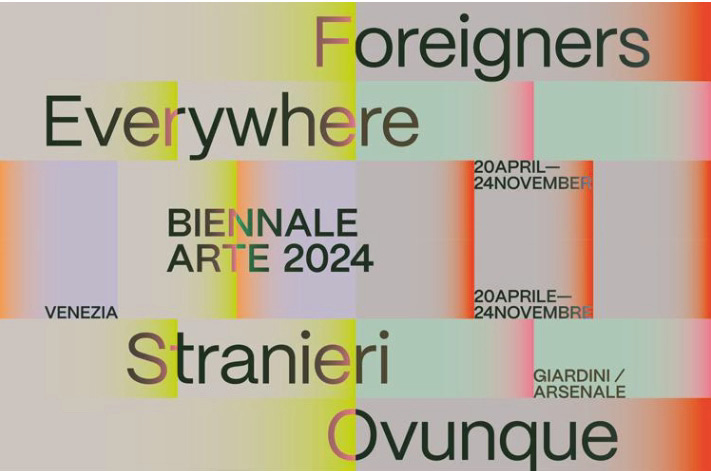
Stranieri Ovunque/Foreigners Everywhere is the title and theme of this year’s Venice Biennale. The Biennale is the world’s oldest international contemporary art event and it opened to the public on April 20 for the 60th time since 1895. This year’s Biennale comprises 88 national pavilions and a large international exhibition of 300 artists curated by Adriano Pedrosa. With its thematic objective, the exhibition and the Biennale as a whole are meant to provide an inclusive forum for all varieties of artistic human beings:
the queer artist, who has moved within different sexualities and genders, often being persecuted or outlawed; the outsider artist, who is located at the margins of the art world, much like the self-taught artist, the folk artist and the artista popular; the indigenous artist, frequently treated as a foreigner in his or her own land.
Pedrosa’s aim is to open up the exclusive perimeters of the contemporary art world and, through this act, encourage visitors to recognize their own and others’ foreignness.
As Pedrosa explains, the term Stranieri Ovunque (Foreigners Everywhere)
has several meanings. First of all, that wherever you go and wherever you are you will always encounter foreigners— they/we are everywhere. Secondly, that no matter where you find yourself, you are always truly, and deep down inside, a foreigner.
At least two reviews, one by Kate Taylor in the Globe & Mail and the other by Jason Farago in the New York Times, have questioned Pedrosa’s effort to bring such diversity together through contemporary art. Can contemporary art really achieve this aim and impact visitors? And, can such events change how we see others in the world?