
Art Animated
Robots and Contemporary Art

Last winter while researching artist robots and AI art, I fell down a rabbit hole. I was intrigued by machine-made art and art-making-machines, all of which are presented as art. We have, for example, drawing machines, like Jean Tinguely’s Metamatics that can make a drawing and are featured in museums as sculptural art objects. We also have AI programs like DALL-E, an “AI art generator” that create images based on spoken or written commands. And, we have artists such as Refik Anadol and collaborative duo, Holly Herndon & Mat Dryhurst, who explore how AI programs can aid in making artworks. And, finally, we have human-like androids like Ai-Da Robot that make artworks and, at the same time, are presented to the public as practicing artists. Each of these examples merges something human – behaviour and physical attributes – with a machine. I was curious then to see how other artists have explored the convergence of humanity and machines. Here are three artists I found down the rabbit hole.
Ronald Brener (1942-2006) was a Canadian artist, who, like Jean Tinguely, created interactive kinetic machines as sculptural artworks. In the early 1980s, he employed basic mechanical devices and electronics to make simple robots that could be activated by the viewer when they pulled a lever, stepped on a pedal, or entered the gallery space. Heart of a Dog (1984), for example, stands six feet high (the approximate height of a tall human) and features a cage-like box at the top that contains two small mechanical dogs. When the viewer steps on a foot pedal at the base of the work, the dogs are activated, and the sound of barking emanates from a speaker on top of the sculpture.
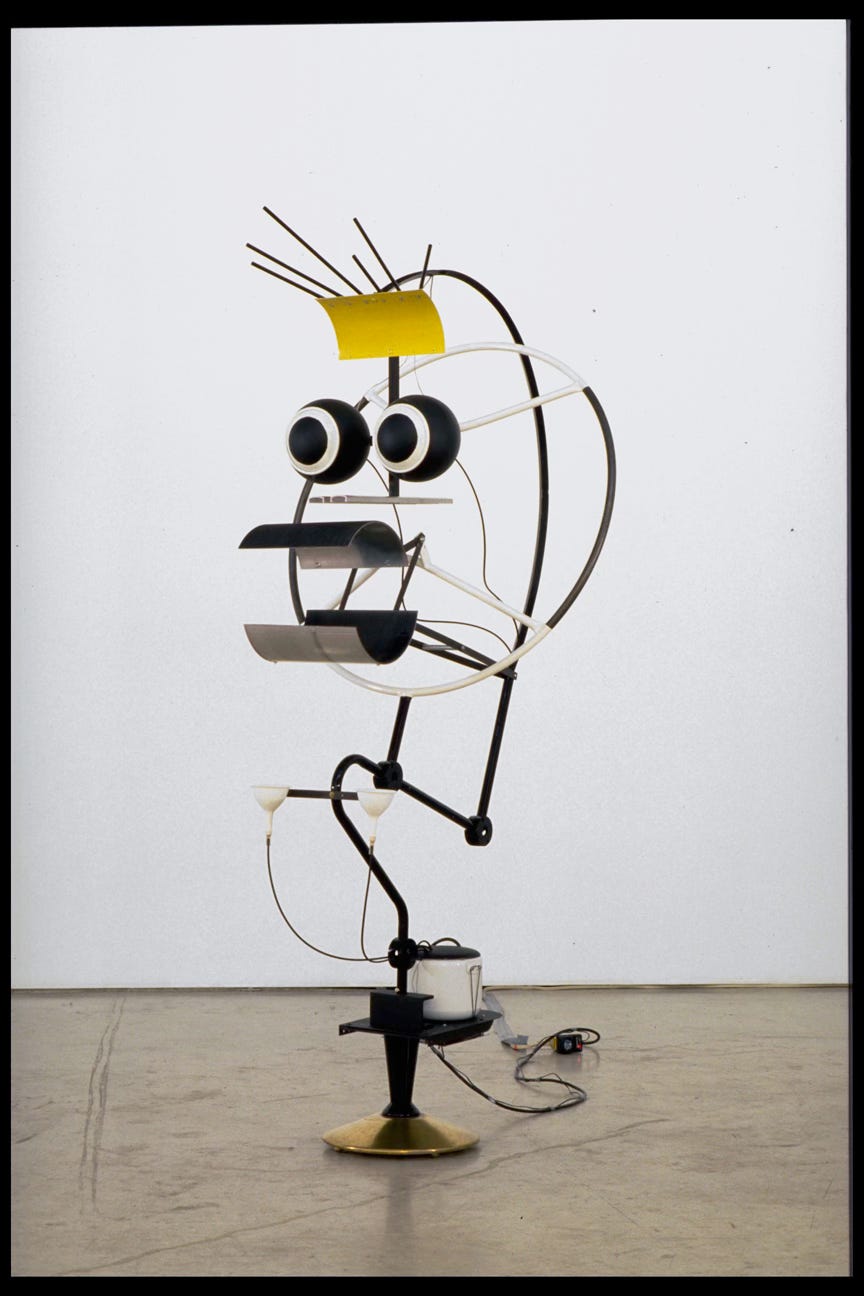
Later in the 1980s, the pose, dimensions, sounds, and behaviour of Brener’s robots became more life-like. Small Talk, (1987) is about 7 feet in height with a face-like circle over a digital sign. When the sculpture is activated the voice of Toronto gallery owner, Olga Korper, recites from a “series of letters received from a debt-collector.” Another work, Weeper (1990) expresses a human emotional attribute, crying. The sculpture has the appearance of a cartoonish human figure with two large eyes and when activated, drops of water are exuded from the eyes and dribble down through a funnel and tubes.
By imbuing his robots with human qualities, Brener was trying to encourage viewers to reflect on our human condition and relationship with others. As he noted, “My hope is that all my art, whatever medium, expresses a feeling of common humanity towards others.”
Empathy with our fellow beings, human and animal, is also a theme explored by another Canadian artist, Bill Vorn and his frequent collaborator, Louis-Philippe Demers. Vorn and Demers have been creating large immersive installations with life-size robots since the 1990s. Their robots do not always take the shape of humans but are designed to either represent human behaviour or trigger empathetic responses in the spectator.
La Cour des Miracles (1997), for example, features six animated machines, each representing a specific behaviour that is triggered by the viewer entering the exhibition space. The Begging Machine, for example, extends an arm made of a suction tube towards the visitor and the Crawling Machine slowly creeps across the floor but tries to flee when approached. These robots are more animal-like in their stature, but their actions are designed to make the viewer consider how we respond to others whether animal, human, or machine.
In later projects, Vorn’s robots better represent the human body and behaviors. DSM-VI (2012) is a large installation that explores what Vorn calls the “psychosis of the machine.” Here Vorn created a suite of robots that illustrate different abnormal behaviours identified in the DSM or Diagnostic and Statistical Manual of Mental Disorders, the medical manual used by psychiatrists. Again, in this installation the human visitor is introduced to what appears to be a dystopian machine world but may recognize in these mechanical others something human all the same.
A more recent installation, I.C.U. (Intensive Care Unit)//Bill Vorn (2021), was featured last Fall at the Centre for Contemporary Art (CCA) in Glasgow, Scotland. In this work, Vorn created a hospital environment where “bedridden, sick, and suffering machines” are suspended in the space as if laid out on gurneys and attached to life support. As in most of Vorn’s installations, the spectator is free to wander through the space witnessing the apparent pain and discomfort of the robots.
Vorn and Demers have also experimented with merging the human body with machines. Inferno (2017), inspired by Dante’s work, is an installation and performance that is meant to represent the bodily experience of hell with its many punishments and loss of autonomy. For this work, Vorn and Demers created 25 wearable robotic suits. The gallery visitors don these suits and take part in the performance. As music plays the human participants can move autonomously at times, but at other times they are forced to take direction from the robotic prosthetic.
Another artist who merges the human body with machines and finds inspiration in Dante’s Inferno is Italian, Marco Donnarumma. Instead of creating human-like machines, Donnarumma attaches AI-driven prosthetics to the human body in his performances. Donnarumma has pioneered what he calls “biophysical music.” Working with neuroscientists he has created prosthetics that, when attached to his body, record the internal sounds. The sound is then sampled by AI and transformed into musical compositions.
Donnarumma has used this prosthetic device in performances. Hypo Chrysos (2012), for example, is Donnarumma’s interpretation of Dante’s classic tale. Donnarumma ties a rope tethered to heavy blocks to each of his arms and drags the blocks around the performance space. The sensors on the ties read and transmit the sound of his muscles and organs, giving an aural form to the interior strain and stress of the human body.
In a more recent work, Donnarumma has continued to develop prostheses, not to improve the body but to challenge how we understand and experience our bodies. For a suite of three performances and two installations, 7 Configurations, he designed AI-driven protheses that are attached to the body. These autonomously mobile extensions respond to the body of the performer but also choose and perform their own actions in relation to the performer. The performer in turn must respond to the actions of the prosthesis.
Each of these examples demonstrates how artists over several decades have worked with mechanical devices, computer programming, and AI technology to shift our understanding of both art and humanity. Sculpture, for example, has traditionally been a mode of production for crafting images of the human body. For centuries, sculptures were carved out of wood or stone or cast in bronze. In the twentieth century sculptors shifted to abstract forms and new materials, but these too often referenced the human body in their scale and verticality. Still, traditional sculptures, with or without human-like qualities, have remained largely static and only able to express emotive characteristics in realistic depictions of faces or through the arrangement of formal elements of the work. Now with robotic technology and the merging of human bodies with machines sculptors can animate their figures, giving them movement and reactive human expression. There is potential then for sculptures to become something very different, mobile, and expressive just like a human performance piece. This leaves me wondering what the future holds as we move into an era where sculptures can autonomously interact with and respond to the viewer.
As sculptures become more life-like we are also increasingly provoked into responding to these creations as if they were sentient beings rather than art objects. The work produced by Brener, Vern and Demers, and Donnarumma suggests that even when something is not human, we tend to empathize with any characteristics we recognize as being like our own. We may then have to ask not only “what is art” but “what is human?”